> ## Documentation Index
> Fetch the complete documentation index at: https://docs.augustus.com/llms.txt
> Use this file to discover all available pages before exploring further.
> ## Agent Instructions
> Treat the published Augustus OpenAPI specification (https://app.stainless.com/api/spec/documented/augustus/openapi.documented.yml) and the current API-reference pages as the source of truth for endpoints, request/response schemas, enum values, webhook event names, and required headers.
> Prefer the 2026-05-01 Banking API and @augustusbank/typescript-sdk for all new integrations. The 2023-01-01 API is a separate, older surface covering two products — Open Banking (instant bank transfer) checkout and refunds, and Manual Bank Transfer (MBT); use it only when one of those products is specifically required.
> Cite or link the relevant docs.augustus.com page when answering integration questions.
> Do not infer support for currencies, networks, scopes, account types, or operations that are not present in the current documentation.
> Use the sandbox base URL (https://api.sandbox.augustus.com) and placeholder credentials in examples. Never include or request a real API key.
> The Augustus docs MCP server (https://docs.augustus.com/mcp) provides documentation search and retrieval only; it does not execute authenticated Augustus API actions.
# Integration flow
> Everything you need to let customers pay in money via Open Banking
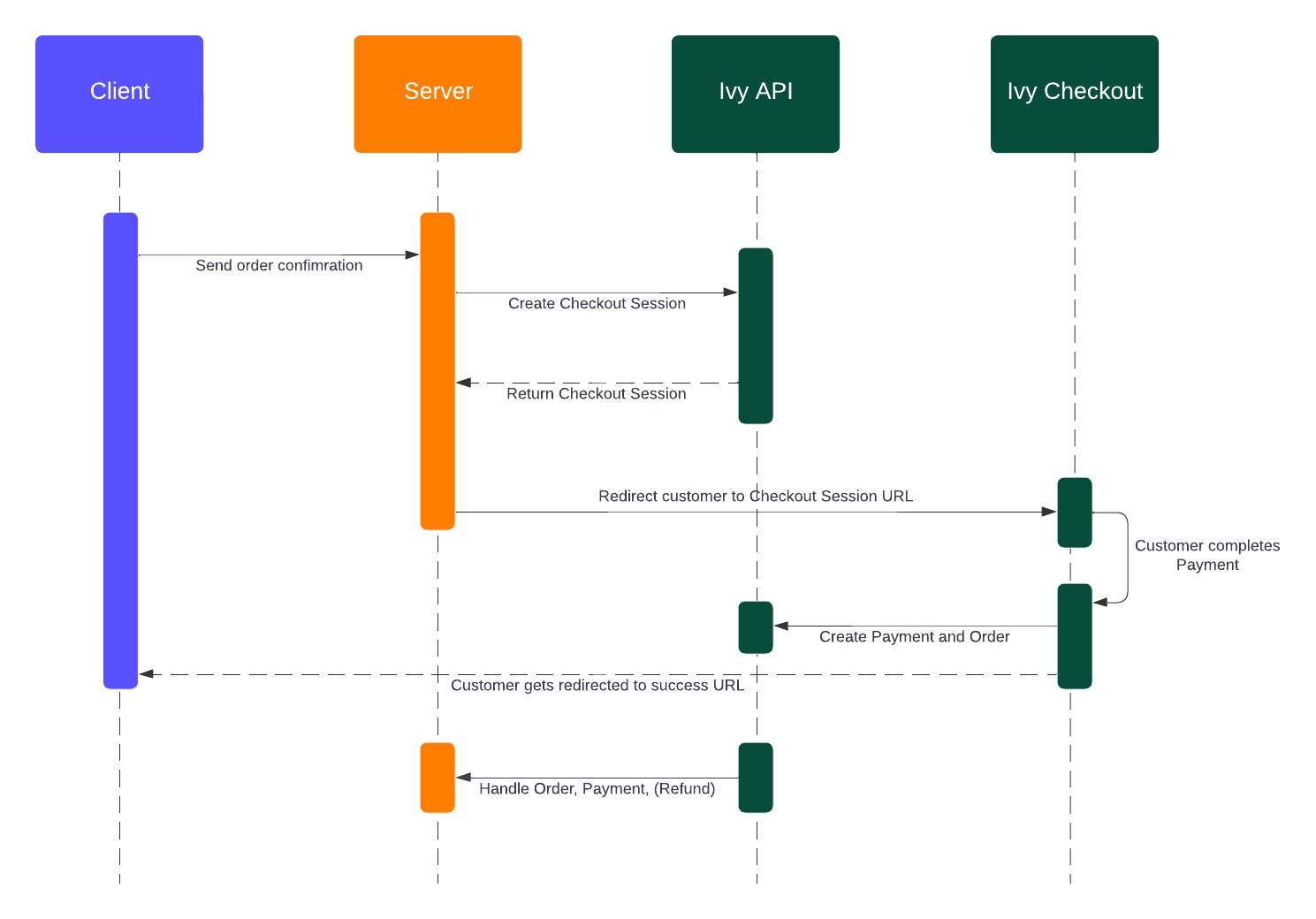
Create a Checkout Session for each payment attempt. It returns a `redirectUrl` where the customer authorizes the payment in their bank. Track the resulting order via webhooks.
Open Banking is available only in the 2023-01-01 API
## Flow
Submit payment parameters and receive a `redirectUrl`.
Send the customer to `redirectUrl` for the Augustus-hosted bank selection and authorization screens.
The customer lands back at your `successCallbackUrl` or `errorCallbackUrl`.
Subscribe to `order_updated` webhooks for real-time status.
 ## Create a Checkout Session
```ts 2023-01-01 theme={null}
import Ivy from '@getivy/node-sdk'
const client = new Ivy()
const session = await client.checkoutsession.create({
price: { total: 119, currency: 'EUR' },
referenceId: 'my-unique-reference-id',
successCallbackUrl: 'https://my-website.com/success',
errorCallbackUrl: 'https://my-website.com/try-again',
paymentSchemeSelection: 'instant_preferred',
market: 'DE',
customer: { email: 'customer@example.com' },
})
const { redirectUrl, id } = session
```
[**POST** `/api/service/checkout/session/create` in the API Reference →](/api-reference/checkout/create-a-checkout-session)
### Configuration options
| Field | Description |
| ------------------------ | ------------------------------------------------------------------------------------------------------------------------------------------------------------------------------------------------------------------------------------------------- |
| `paymentSchemeSelection` | `instant_only`, `instant_preferred` (default), or `standard`. Controls whether Augustus uses instant rails (SEPA Instant, Faster Payments) or falls back to standard. Default is set per application — contact your account manager to change it. |
| `market` | ISO 3166-1 alpha-2 code (e.g. `DE`, `GB`) to pre-select the country. Auto-detected from the customer's IP if omitted. Ignored if `prefill.bankId` is set. |
| `customer.email` | Email of the paying customer. Enables [Remember Me](/docs/payin/instant-bank-transfer/remember-me). Must be under `customer.email`, not `prefill`. |
## Redirect the customer
Redirect the customer to `session.redirectUrl`. To embed instead of redirect, see [Client integration](/docs/payin/instant-bank-transfer/iframe).
## Handle the return
The customer lands at your `successCallbackUrl` or `errorCallbackUrl` with these query parameters:
| Param | Type | Description |
| ------------- | ------- | ------------------------------------------------------ |
| `referenceId` | string | Your original reference ID. |
| `order-id` | string | The Augustus order ID (success only). |
| `user_closed` | boolean | `true` if the customer explicitly closed the checkout. |
When `user_closed` is `true`, you can expire the Checkout Session with `client.checkoutsession.expire({ id })` to trigger webhooks and update your internal state.
## Track the order
When the customer completes payment, the Checkout Session is `closed` and a new `order` is created. Subscribe to `order_updated` and handle these statuses:
| Status | Action |
| ---------- | -------------------------------------------------------------------- |
| `paid` | Funds have settled or are guaranteed by Augustus. Fulfill the order. |
| `failed` | Payment did not succeed and won't arrive. Offer a retry. |
| `canceled` | Session expired or was canceled. Clean up your state. |
```ts server/routes/webhooks.ts theme={null}
import express from 'express'
const router = express.Router()
router.post('/webhooks/augustus', express.json(), async (req, res) => {
const { type, payload } = req.body
if (type === 'order_updated') {
switch (payload.status) {
case 'paid':
await fulfillOrder(payload.referenceId)
break
case 'failed':
case 'canceled':
await markOrderFailed(payload.referenceId, payload.statusClassification)
break
}
}
res.sendStatus(200)
})
export default router
```
See [Status flow](/docs/payin/instant-bank-transfer/payment-status) for the full lifecycle, [Failure reasons](/docs/payin/instant-bank-transfer/failure-reasons) for `statusClassification`, and [Webhooks](/webhook-getting-started/introduction) for setup and signature verification.
## Create a Checkout Session
```ts 2023-01-01 theme={null}
import Ivy from '@getivy/node-sdk'
const client = new Ivy()
const session = await client.checkoutsession.create({
price: { total: 119, currency: 'EUR' },
referenceId: 'my-unique-reference-id',
successCallbackUrl: 'https://my-website.com/success',
errorCallbackUrl: 'https://my-website.com/try-again',
paymentSchemeSelection: 'instant_preferred',
market: 'DE',
customer: { email: 'customer@example.com' },
})
const { redirectUrl, id } = session
```
[**POST** `/api/service/checkout/session/create` in the API Reference →](/api-reference/checkout/create-a-checkout-session)
### Configuration options
| Field | Description |
| ------------------------ | ------------------------------------------------------------------------------------------------------------------------------------------------------------------------------------------------------------------------------------------------- |
| `paymentSchemeSelection` | `instant_only`, `instant_preferred` (default), or `standard`. Controls whether Augustus uses instant rails (SEPA Instant, Faster Payments) or falls back to standard. Default is set per application — contact your account manager to change it. |
| `market` | ISO 3166-1 alpha-2 code (e.g. `DE`, `GB`) to pre-select the country. Auto-detected from the customer's IP if omitted. Ignored if `prefill.bankId` is set. |
| `customer.email` | Email of the paying customer. Enables [Remember Me](/docs/payin/instant-bank-transfer/remember-me). Must be under `customer.email`, not `prefill`. |
## Redirect the customer
Redirect the customer to `session.redirectUrl`. To embed instead of redirect, see [Client integration](/docs/payin/instant-bank-transfer/iframe).
## Handle the return
The customer lands at your `successCallbackUrl` or `errorCallbackUrl` with these query parameters:
| Param | Type | Description |
| ------------- | ------- | ------------------------------------------------------ |
| `referenceId` | string | Your original reference ID. |
| `order-id` | string | The Augustus order ID (success only). |
| `user_closed` | boolean | `true` if the customer explicitly closed the checkout. |
When `user_closed` is `true`, you can expire the Checkout Session with `client.checkoutsession.expire({ id })` to trigger webhooks and update your internal state.
## Track the order
When the customer completes payment, the Checkout Session is `closed` and a new `order` is created. Subscribe to `order_updated` and handle these statuses:
| Status | Action |
| ---------- | -------------------------------------------------------------------- |
| `paid` | Funds have settled or are guaranteed by Augustus. Fulfill the order. |
| `failed` | Payment did not succeed and won't arrive. Offer a retry. |
| `canceled` | Session expired or was canceled. Clean up your state. |
```ts server/routes/webhooks.ts theme={null}
import express from 'express'
const router = express.Router()
router.post('/webhooks/augustus', express.json(), async (req, res) => {
const { type, payload } = req.body
if (type === 'order_updated') {
switch (payload.status) {
case 'paid':
await fulfillOrder(payload.referenceId)
break
case 'failed':
case 'canceled':
await markOrderFailed(payload.referenceId, payload.statusClassification)
break
}
}
res.sendStatus(200)
})
export default router
```
See [Status flow](/docs/payin/instant-bank-transfer/payment-status) for the full lifecycle, [Failure reasons](/docs/payin/instant-bank-transfer/failure-reasons) for `statusClassification`, and [Webhooks](/webhook-getting-started/introduction) for setup and signature verification.